Episode 1 - Agnieszka
CADIS International, together with the Polish Camillian Province and the Tzu Chi Buddhist Charity Foundation, has been working for almost three years in Poland to assist the Ukrainian population fleeing the war that has devastated entire cities and forced millions of civilians to flee.
Ours is a long-term intervention, carried out thanks to the Tzu Chi Foundation as the main funder and thanks to the dedication of dozens of people who work every day for and with the people hosted in the Camillian facilities.
Over time we have collected the voices and testimonies of many Ukrainian women who have benefited from our support. Now we want, with a series of interviews, to share the valuable testimony of those who, behind the scenes, are part of the precious team that assists the guests in various areas. This is also a way to thank all those who, from the very first days of the war, have been on the front lines to welcome and assist the tens of thousands of Ukrainians fleeing the war.
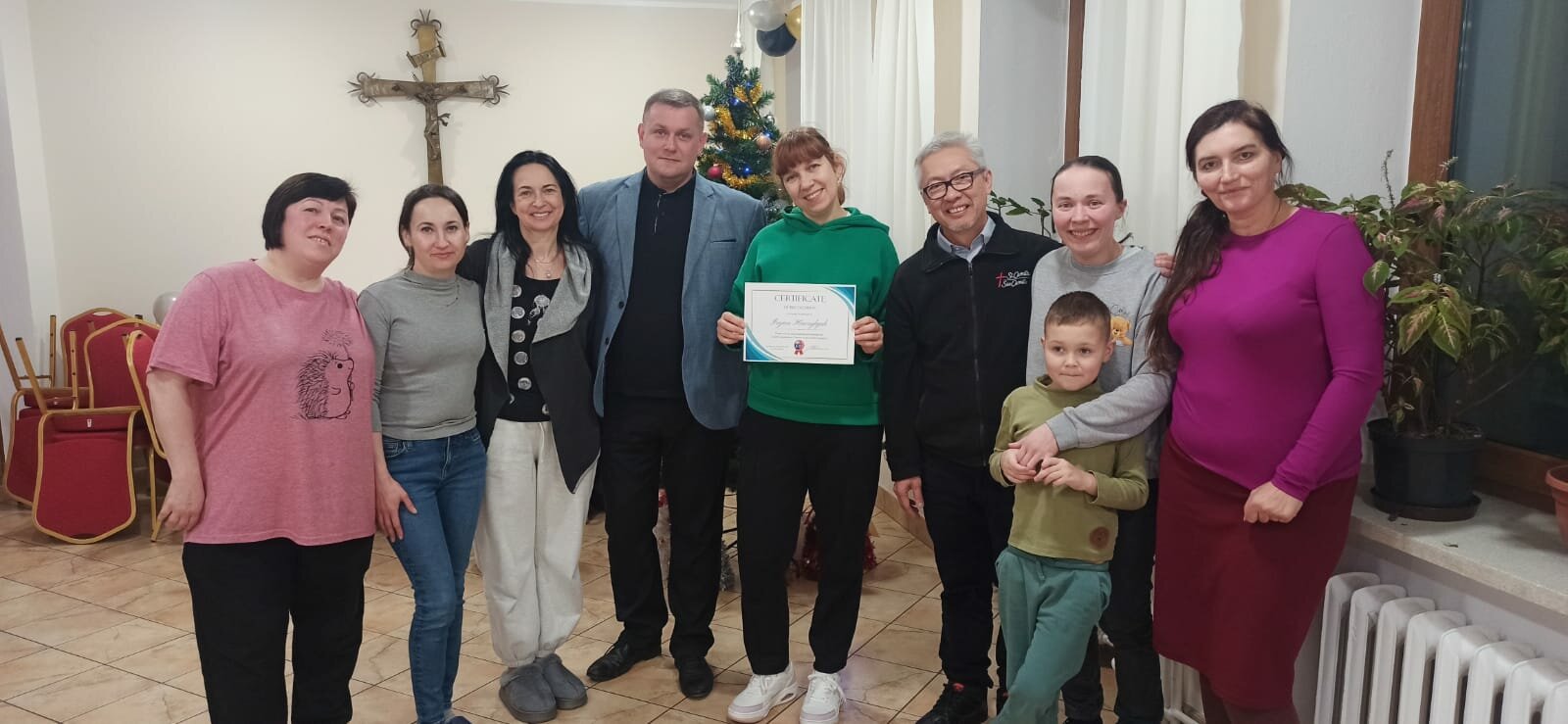
We present Agnieszka, coordinator of the program at the Lomianki facility, who works closely with Father Roman, local superior of the Camillian community of Lomianki. Agnieszka has been involved in the project to build the resilience of Ukrainian refugees since the beginning of the crisis. She has carefully lent her ears and her heart to listen to the needs of the guests, comfort them, or embrace them when necessary. Professionally and maternally, this is how she recounts her journey with the Ukrainians in Lomianki.

What are your first memories related to the arrival of refugees in Poland?
My first memories of the outbreak of war in Ukraine and the exodus of refugees to Poland are linked to my volunteering as a collaborator at the parish of Santa Margherita in Lomianki. At the request of the parish priest, I was in charge of coordinating the search for Polish families willing to take in under their roof the Ukrainian refugees who were arriving en masse in Warsaw. The Polish volunteers who were waiting for the refugees at the train stations or those who went directly to the border would call me to tell me which family they had taken in, and I had to find a place for them with the families of Lomianki. The phones rang from the early hours of the morning until late at night. There were hundreds of planes trying to land on congested runways. During those days I was very moved. The search for places for the refugees went on for several weeks. That is how I arrived at the House of the Camillian Fathers in Lomianki.
What were the biggest difficulties and how were they overcome (or not)?
The biggest difficulties were related to the accommodation of people with disabilities, who required special housing. At that time, I sought contacts with Polish foundations that deal with disabled people and we placed these refugees in homes managed by them. Sometimes it was possible to find a Polish family with the necessary experience to host these people. Another difficulty was the communication between the refugees and the Polish families due to the language gap. I received many phone calls asking me to intervene. For me, it was an emotional and linguistic challenge, since I had learned Russian a long time ago and it was a starting point for communicating with the Ukrainian refugees.
Then we had to deal with symptoms of post-traumatic stress, a consequence of the unexpected change in their life situation. Many of them had never had the experience of leaving their own country. I encouraged Polish families to use guides on how to behave with refugees.

How has the approach of refugees changed over the years?
I believe that most of them have already decided to settle in Poland, if the residency regulations allow it. They are aware of the difficult living conditions in Ukraine after the war (the country is devastated by financial problems). Therefore, they are doing their best to adapt to the new reality, working hard and learning the Polish language. Some of the refugees, especially those less adapted to the new life in Poland, still wish to return to Ukraine. Most of them have difficulty learning the language and the Polish system.
What is the current situation of refugees in Poland?
The situation at the border between Poland and Ukraine is stable; the border service has not recorded much traffic. In the first quarter of this year, legislative projects related to regulatory changes will take place, namely the extension of the deadline for the legal stay of Ukrainians in Poland until March 2026 (according to the EU directive). Currently, about 30,000 people are staying in collective accommodation centers (OZZ); the participation of people with disabilities and the elderly represents about 17% of this number. 45% of people are completely exempt from the accommodation fee. The project “Together for Independence,” implemented by the Polish Red Cross and the Polish Center for International Aid, which operates in the sector of supporting refugees in renting apartments, intends to move funds for support for social and economic integration. There is a high demand for professional courses and thus the need to find funding.
Currently, most of the residents of our house have a permanent job, the others - occasional work. Only a small percentage work in a job related to their education. This is due to the impossibility of recognizing Ukrainian university degrees. Furthermore, to study in Polish schools or universities, a Polish language certificate is required. The most talented, younger Ukrainian citizens and those who have the funds to do so accept this challenge. The others are forced to do simple jobs, usually below their qualifications. In the process of integration with Polish society, children are the best, the greatest difficulties are for the elderly and less educated people who rely on the help of their loved ones living with them in Poland or those who already know the Polish system well.
What are the expectations for the coming months?
As long as the war in Ukraine continues, we can consider any scenario. We, as coordinators of the aid program, are carrying out our mission at the House of Lomianki. At this stage of the program, we are emphasizing the complete independence of refugees through a fully conscious entry into the Polish social, educational, and work system.


.jpeg "child-international-day-lomianki-jun22-(12).jpeg")
What is the feeling regarding the end of the war?
We don't know when this war will end. But if it does end, Ukraine will face the consequences for a long time, both economically and socially. Some people may have nothing left when they return there.
Can you tell us about an episode or a story that particularly touched you?
This work as a social worker and program administrator in the Lomianki home community requires, on the one hand, compassion and love for others but, on the other, great commitment, tenacity, and consistency in action. This type of professional work also unconsciously affects my private life. The human drama but also the immense gratitude of the refugees are the daily reality of my work.
A particular episode: Antonina, a 58-year-old disabled woman from Mikolayev, arrived in Poland with her 85-year-old mother. Due to her physical handicap, it was necessary to obtain a Polish disability certificate to ensure financial support and adequate medical care. I went with her to the clinic for a chest X-ray. The technician asked her to lie down on a special table, but due to her short stature and foot deformity, she was unable to get on it. I had to lift her and place her on the table. After securing her, the table began to move into a vertical position; she needed to hold onto the edges with her hands, but Antonina was not strong enough to keep her balance. She began to slip off the platform. To take the necessary picture, I put on protection against X-rays and held her upright. It worked! But honestly, I was afraid I had received a dose of radiation. However, I managed.
A touching story: Tetyana, a thirty-year-old mother of two children aged 2 and 3, in February 2022, during a journey of several days fleeing the war towards Poland, experienced the difficulties of crossing the border, the cold, and the uncertainty of her fate. On an unheated bus on the way to the Polish border, she gives the leftover milk to her crying children. She warms the liquid with her mouth before feeding the child.