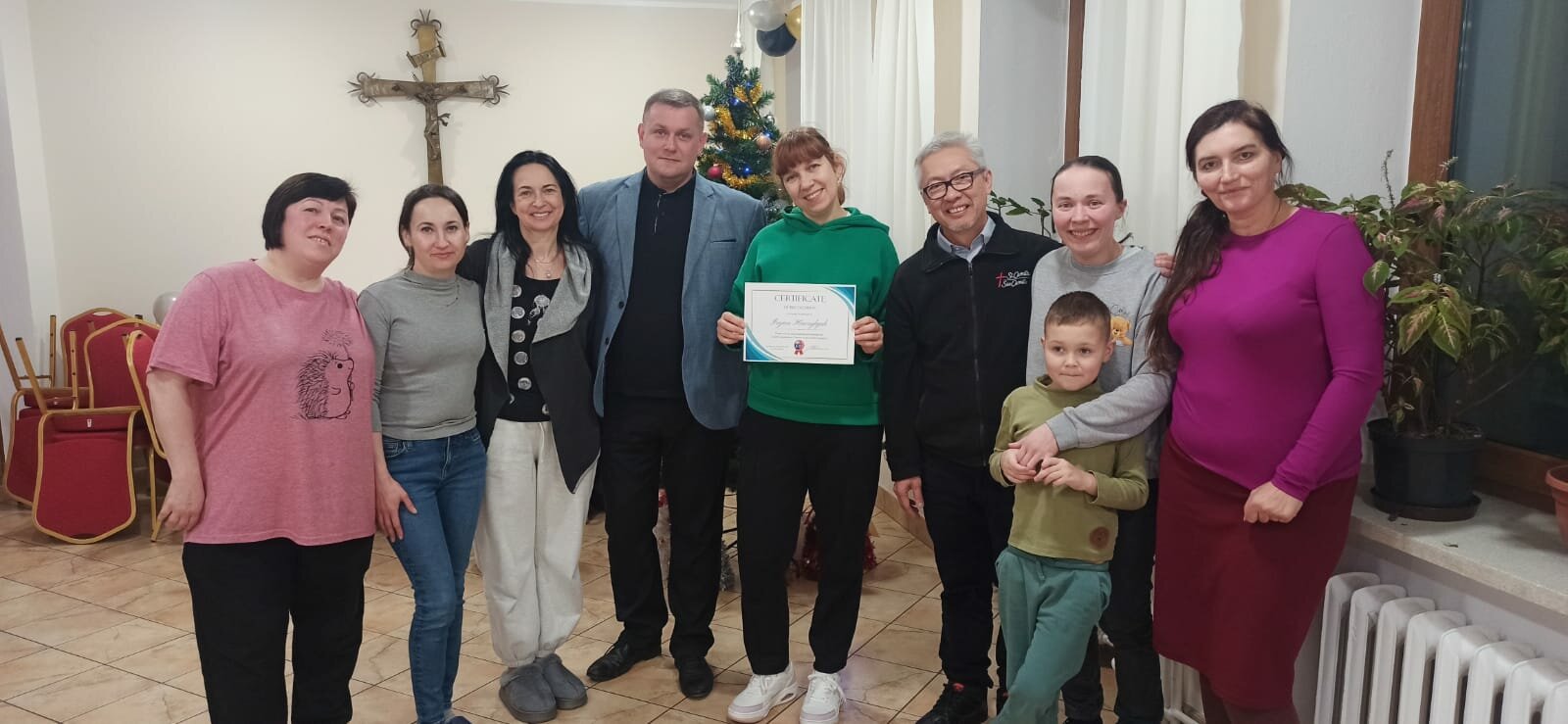
The post-emergency project entitled “Reconstruction and strengthening of resilience for the adaptation and integration of Ukrainian refugees in Poland”, following the 2023 project, seeks to fill the main gaps in the assistance provided to Ukrainian refugees.
The main objective of the project is to help refugees gradually adapt and integrate into Polish society. The project foresees two specific outcomes: that Ukrainian refugees (a) settle in regular apartments and (b) engage in part-time or full-time work or self-employment.
At the end of 2023, the Camillians assisted 82 refugees, including children and the elderly. On the other hand, over 11,000 refugees living outside our shelters or new arrivals received food and non-food assistance.
The nature of this second phase is to support the prevailing needs (work, housing, and healthcare) of the seventy-five (75) Ukrainian refugees (women, children, elderly) in the Camillian accommodations in Ursus and Łomianki and the ongoing assistance (information, food and non-food) to another 1,000 refugees outside the Camillian shelters.

(1) Provide long-term shelter to 75 refugees (women and children or families) in Łomianki and Ursus
As of March 2024, seventy-eight (78) direct beneficiaries, including children (32 boys and 46 girls), have been assisted by the project programs in Ursus (43) and Łomianki (35).
In Łomianki, the children study in Polish public and private schools. Most of them are determined to stay permanently in Poland. All the mothers work. However, the salary they receive is the lowest in the country, which is a concern for those who decide to emigrate to Poland. The families staying in our Łomianki shelter have a six-month contract (until June 30, 2024), renewable for another six months.
In Ursus we have rented 8 training apartments that are offered mainly to mothers with children. As of March 31, we had 20 guests in the apartments. They have stable jobs and one of the refugees, who is a neurologist, after a long procedure with our support, obtained recognition of her profession. The children have integrated very well with their Polish peers. They speak Polish well and get good grades at school. Their family life is normalizing and improving.
Our housing support is also available for the elderly. Unfortunately, the elderly have difficulty learning the Polish language. In addition, they need careful medical assistance.
The administrations of Łomianki and Ursus, together with all the staff and volunteers, ensure the regular implementation of the entire project every day. Each staff member has well-defined roles and responsibilities.
(2) Facilitate refugees' access to the labor market to obtain part-time or full-time jobs and coworking space for qualified refugees interested in self-employment or alternative livelihood activities
Every resident in good health and able to work is motivated by the coordinator to learn Polish and look for a job. However, the most significant challenges are language proficiency and the lack of stable jobs available on the market. Another practical challenge is the lack of authentication of Ukrainian diplomas and professional titles. Cultural mediation support is also available for newcomers.
Starting from the first quarter, the Harna coworking space is used by 52 Ukrainian refugee women. The workstations are used on a rotating basis. The manicure station is the most popular and frequented. The coworking program is attracting a lot of interest and popularity, and requests have been made for other locations in Warsaw. Ukrainian refugees are eager to use and improve their skills. A program coordinator has been assigned to the coworking space. However, due to the increasing costs of maintaining the space in terms of rent and operating expenses, the coworking space is hardly economically self-sufficient using users' financial contributions. The team is trying to find a cheaper space and secure external funding.

(3) Counseling points
The Camillians continue to run an information and assistance point for war refugees from Ukraine at the Warsaw West and East stations. In these three months, 10,276 people have received assistance from coordinators and volunteers. People in economic difficulty turn to the Ursus facility, where we provide assistance in the form of food and hygiene packages. In addition, in cooperation with the WHO, the Camillians have conducted a free HIV testing program for Ukrainian refugees: those who tested positive received detailed information about free treatment in Poland.
Conclusion
Every month we serve an average of 71 refugees in Ursus and Łomianki. Some refugees have returned to Ukraine, while others arrive at our Center. More than 30 refugees work or carry out their own activities in the coworking space. The main gaps, such as language proficiency (reading and writing) and safe job placement, remain difficult for various reasons. However, considering their condition, the goal of integration and adaptation to Polish society is making a lot of progress.
After two years of hospitality in Poland, many people in transit remain in precarious situations. Many people still rely on unsustainable housing, need humanitarian assistance to survive, struggle to find ways to improve their long-term situation, suffer the impact of stress and trauma among children and adolescents, tensions within the Ukrainian community itself, and issues related to protection status, labor market exploitation, and discrimination (see IRC, 2023). CADIS and the Camillians remain committed to supporting the results achieved in the last two years of work and accompaniment of people displaced by the war.